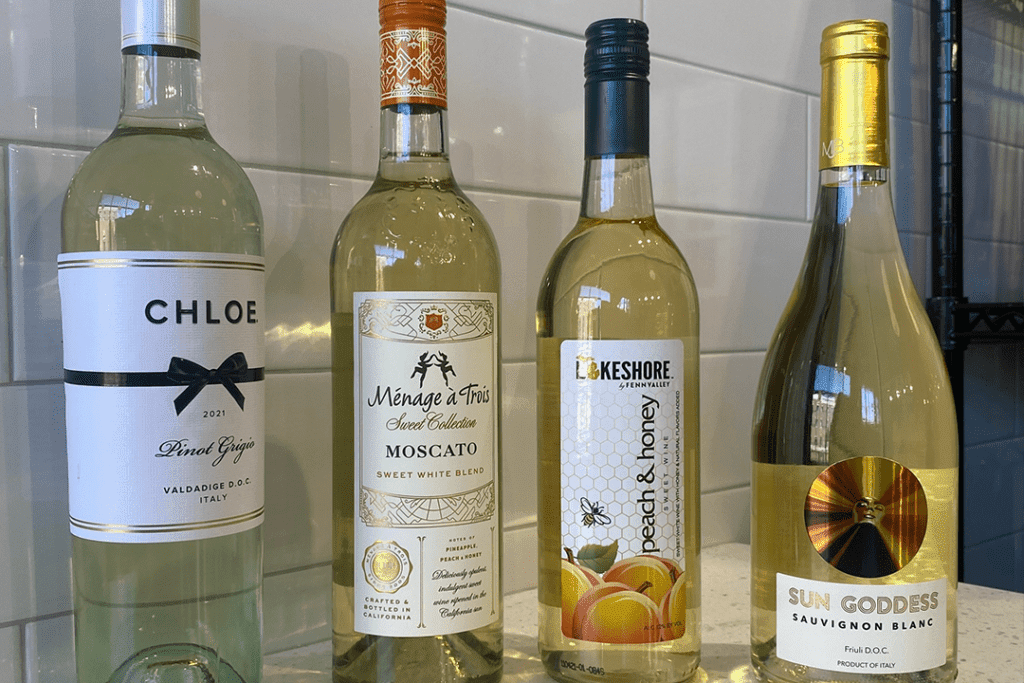
White wine has existed for at least 4,000 years. People often serve white wines as an apéritif before a meal, with dessert, or as a refreshing drink between meals. Many people consider white wines more refreshing and lighter in both style and taste than most red wines. Their acidity, aroma, and ability to soften meat and deglaze cooking juices also make people use white wines frequently in cooking.
The wide variety of white wines comes from the large number of varieties, methods of winemaking, and ratios of residual sugar. White wine is mainly from “white” grapes, which are green or yellow in color, such as the Chardonnay, Sauvignon Blanc and Riesling. Winemakers also make some white wine from grapes with colored skin, as long as the obtained wort does not become stained. For example, they commonly use Pinot Noir to produce Champagne.
Among the many types of white wine, dry white wine is the most common. Winemakers produce it through the complete fermentation of the wort (the grape juice from the initial pressing process), giving it a more or less aromatic and tangy character. On the other hand, they produce sweet wines by interrupting fermentation before all the grape sugars convert into alcohol; they call this process Mutage or fortification. The methods of enriching wort with sugar are multiple: on-ripening on the vine, passerillage (straining), or the use of noble rot. Winemakers produce sparkling wines, which are mostly white, by keeping the carbon dioxide from fermentation dissolved in the wine, so it turns into gas when they open the bottle.
Fermentation Process
White wine is fermented without skin contact. This means the skins are removed immediately after pressing. The color can be straw-yellow, yellow-green, or yellow-gold, the variety produced by the alcoholic fermentation of the non-colored pulp of grapes.
Winemakers place the wort, mentioned above, in a tank to undergo fermentation. Yeast synthesizes most of the aromatic components (acetates of alcohol and ethyl esters of fatty acids) during the fermentation of light juice below 18°C.
Fermentation starts spontaneously under the action of the natural yeasts from the grapes. The winemaker can choose to use a commercially available active dry yeast. It can help to express the characteristics of a variety or a method of manufacture. For a dry white, wine fermentation continues until the sugar runs out. Winemakers then usually decant the wine to eliminate the lees. When they carry out fermentation in barrels, the temperature often exceeds 20°C or even reaches 25°C.
After the end of fermentation, the wine may also have malolactic fermentation or FML. This second fermentation carried out by bacteria deacidifies the wine: it transforms the malic acid into lactic acid. Winemakers do not always consider this operation desirable, and they do not always practice it. For example, in southern regions, winemakers carefully preserve acidity to maintain the wine’s liveliness and refreshing aroma. During grape fermentation, the wine develops greater roundness and volume during aging in oak barrels, while varietal aromas gradually reduce in intensity.
For a sweet wine, fermentation is stopped before its end to keep some of the sugar: this is the Mutage (fortification). An addition of wine alcohol stops the fermentation. For sweeter dessert wines, fermentation stops spontaneously by excess sugar and alcohol: Alcohol is waste from the yeast and it is poisonous in large doses. In the case of sweet wines, FML is not done for sweet wines as the lactic bacteria preferentially degrades sugar which would give a lactic bite (sweet and sour wine). In addition, the balance of acidity and sugar in the wine supports vivacity.
Maturing the Wine
Winemakers can carry out maturing in a vat. They clarify the wine quickly and prepare it for packaging, such as bottling or Bag-In-Box. They can also extend this stage by maturing the lees. This type of maturing consists of regularly adding fine lees in suspension in the wine. Winemakers use dead yeast as fine lees. It digests itself through autolysis, adding volume and body to the wine while enhancing its fruitiness. Winemakers call this process Bâtonnage, or stirring. They traditionally perform it with a stick to agitate the lees at the bottom of the barrel. They must control this technique carefully. Otherwise, the wine can develop a Goût de réduit (reduced taste). This happens due to the activity of reductase sulphite from the yeast. Winemakers carry out this operation in different ways. Winemakers use vats in Muscadet. In Burgundy and many Chardonnays, they use barrels. For Champagne, they also use bottles.
Winemakers can also carry out maturing in barrels. They put the wine into barrels after fermentation, although fermentation itself can also take place inside the barrel. The barrel has a dual role: it flavors the wine giving it a scent of toast, butter, and vanilla but it also helps to mature it by providing a very small regular quantity of oxygen through the wooden walls. This oxygen helps to polymerize the components of the wine making it less aggressive and more balanced.